Tracing Live Odds Delivery Mechanics in Licensed Mobile Platforms for Nordic Users
Uma Lorenz · Aug 18, 2026

Tracing Live Odds Delivery Mechanics in Licensed Mobile Platforms for Nordic Users
Licensed mobile platforms serving Nordic users rely on precise live odds delivery systems that push real-time data from external providers into user interfaces while meeting strict regulatory standards across Sweden, Denmark, Norway and Finland. These mechanics involve layered API connections, timestamp verification protocols and low-latency distribution networks that operators must maintain to keep betting markets current during events.
Regulatory Framework Governing Nordic Mobile Platforms
National authorities require licensed operators to demonstrate full control over odds delivery pipelines, including audit trails that record every update and source attribution. The Swedish Gambling Authority publishes detailed technical guidelines that mandate maximum latency thresholds and data integrity checks for all live betting products offered to Swedish users, while similar rules apply under Danish and Norwegian licensing regimes. Observers note that these frameworks evolved to address risks associated with delayed or manipulated feeds, and compliance audits now routinely examine the full chain from odds compiler to mobile screen.
Operators integrate certified third-party data feeds that undergo continuous validation against independent monitoring services, and failure to maintain these standards can result in temporary suspension of live betting features. Data from regulatory reports shows that licensed Nordic platforms processed millions of live odds updates daily in 2025, with the majority completing transmission cycles in under two seconds.
Technical Pathways for Real-Time Odds Updates
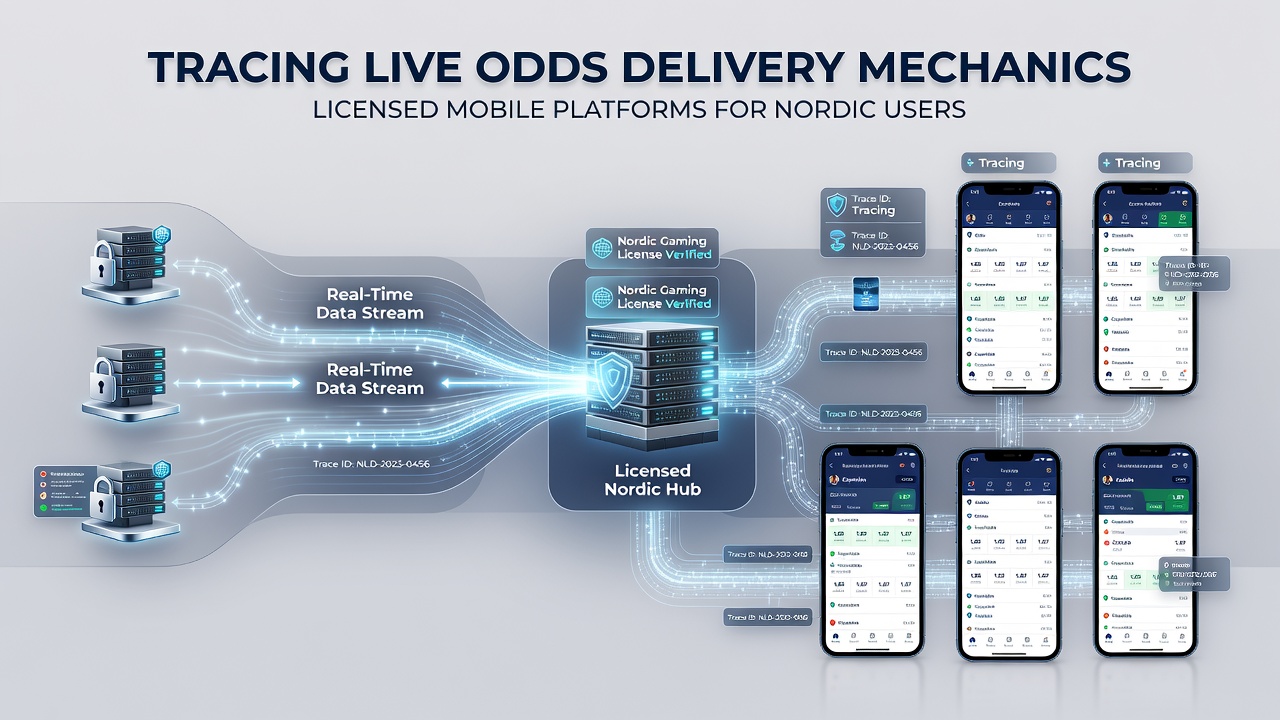
Live odds delivery begins when event data arrives from sports data aggregators through secure sockets or REST endpoints, after which proprietary algorithms calculate revised probabilities and transmit the new figures to mobile clients. The process uses push notifications and websocket channels that keep connections open, allowing incremental changes to appear without full page reloads on user devices. Nordic operators often deploy edge servers located within regional data centers to shorten transmission distances and satisfy local data residency expectations.
Timestamp synchronization forms a critical component, because any discrepancy between the feed origin and the displayed value can trigger automatic market suspension under licensing conditions. Engineers implement checksum verification at multiple nodes along the delivery path, and systems log each modification for post-event review by compliance teams.
Mobile Client Integration and Display Logic
Applications on iOS and Android devices receive compressed data packets that the client software decompresses and renders according to pre-approved templates, ensuring that fractional odds, decimal formats and American styles display correctly for each market. Battery and network optimization routines pause non-essential background polling when users minimize the app, yet live markets resume instantly upon return. Developers incorporate fallback mechanisms that switch to secondary feeds if primary connections degrade, maintaining service continuity during peak event periods.
Security Protocols and Data Integrity Measures
Encryption standards such as TLS 1.3 protect all live odds transmissions between servers and mobile endpoints, while additional application-level signing prevents interception or alteration during transit. Licensed platforms conduct regular penetration testing focused specifically on the odds pipeline, and findings feed into quarterly reports submitted to oversight bodies. Research indicates that multi-factor authentication for backend access combined with role-based permissions reduces the likelihood of unauthorized changes to active markets.
Geolocation verification adds another layer, because Nordic regulations restrict certain live betting options to users physically located within permitted territories, requiring the platform to cross-reference device location signals with odds delivery eligibility rules before rendering markets.
Developments Observed Through August 2026
By August 2026, several Nordic operators had introduced enhanced predictive caching that anticipates score changes and pre-loads probable odds revisions on the device, cutting visible latency even further during high-volume events. Regulatory updates in the same period clarified requirements for artificial intelligence assisted odds compilation, demanding that any automated adjustments remain traceable to human oversight logs. Industry associations across the region reported collaborative testing of standardized APIs that could streamline integration between data providers and multiple licensed platforms simultaneously.
These advancements build on earlier infrastructure investments, and figures reveal continued growth in the proportion of betting activity occurring through mobile channels among Nordic users. External monitoring services now offer real-time dashboards that regulators and operators can access to verify delivery performance across borders.
According to information published by the Swedish Gambling Authority, technical compliance reviews increasingly focus on end-to-end traceability rather than isolated component checks. A separate analysis from the Victorian Responsible Gambling Foundation examined comparable real-time systems in another jurisdiction and highlighted the value of redundant verification nodes for maintaining market fairness.
Conclusion
Live odds delivery in licensed Nordic mobile platforms depends on tightly integrated technical, regulatory and security components that together ensure timely, accurate and compliant presentation of betting markets. As infrastructure continues to evolve through 2026 and beyond, operators maintain focus on verifiable data pathways that satisfy both user expectations and licensing obligations across the region.